Mines sits among the most-played titles in the Rollbit Originals lineup — and the 99.20% RTP is a big part of why. Built entirely in-house by the Rollbit team, it’s not a licensed slot or a reskinned third-party game. The concept is straightforward: a grid filled with gems and hidden mines, a growing multiplier with every safe cell opened, and one decision that runs through every round — when to cash out.
What makes Rollbit Mines worth paying attention to beyond the numbers is how it handles fairness. Every round in this provably fair grid game is calculated mathematically before it starts, with results that can be independently verified after the fact. The Challenge Pool adds a live prize element visible to all players, and the whole thing runs through the same Rollbit account used for every other Original — no separate setup, no additional registration required.
How Does Rollbit Mines Work?
The grid contains a mix of gems and mines — the exact positions are hidden, and the player’s job is to reveal gems without landing on one. Each safe cell opened pushes the multiplier higher, and the round stays active until either a mine is hit or the player cashes out.
Key rules:
- Every cell is either a gem or a mine — nothing in between
- Opening a gem increases the multiplier; hitting a mine ends the round and loses the stake
- The number of mines on the grid is set before the round starts
- More mines = higher multiplier per gem, but less room for error
- Cashout can be triggered at any point after the first gem is revealed
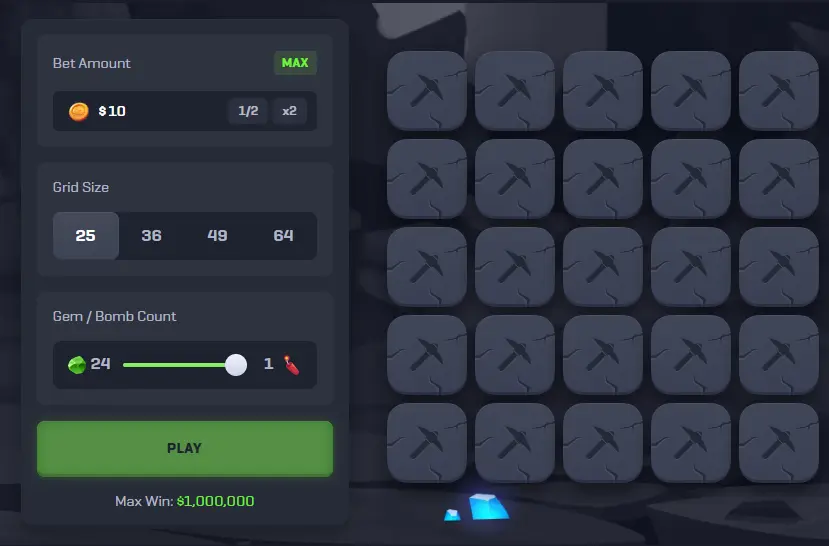
Grid Size and Bomb Count: How to Configure Your Game
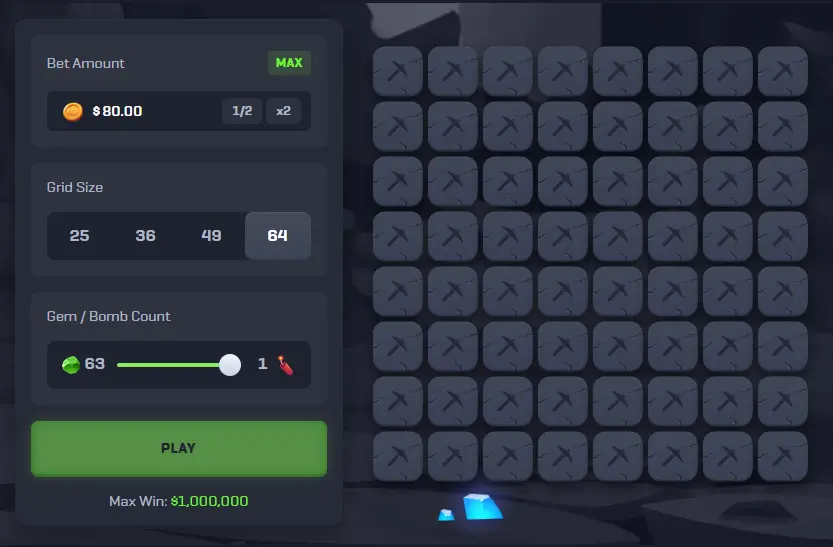
Before each round, two variables are set: the grid size and the number of bombs placed within it. Both are locked in once the game starts — neither can be adjusted mid-round.
The relationship between bomb count and potential payout is direct: more bombs means fewer safe cells, which means each gem opened carries more weight in the multiplier calculation. The trade-off is obvious — higher mines grid configuration risk, higher reward.
| Bombs on Grid | Risk Level | Approx. Multiplier After 3 Gems |
| 1–3 | Low | ~x1.2 – x1.5 |
| 5–8 | Medium | ~x1.8 – x2.5 |
| 10–15 | High | ~x3.5 – x6.0 |
| 20+ | Very High | x10.0+ |
These figures are approximate — actual multipliers depend on grid size and the specific combination selected.
How the Multiplier Grows in Mines
The multiplier doesn’t move in equal steps — it accelerates. Opening the first gem adds a modest amount; by the time a player is deep into a grid with few cells left, each new reveal carries significantly more weight than the one before it.
The logic behind this is probability: as more gems are uncovered, fewer safe cells remain, and the mathematical likelihood of hitting a mine increases with every move. The payout growth reflects that increasing risk. A player sitting at x8 with three cells left is in a very different position than someone at x8 with fifteen cells still hidden — same multiplier, completely different risk profile.
The current multiplier is visible at all times before cashout, so the decision is never made blind.
Cashout Strategy: When to Stop in Mines Game
There’s no universally correct moment to cash out — the game is built around that uncertainty. What differs between players is how they manage it.
Early cashout — open two or three gems and leave. The multiplier won’t be dramatic, but the bet comes back with a small gain far more often than it’s lost. Players who run high volume at low margins tend to favour this approach for mines risk management.
Mid-range play — reveal roughly half the safe cells before exiting, targeting a multiplier in the x3–x5 range. This sits in the middle ground between frequency and size, and works best with moderate bomb counts where the grid still has breathing room.
Aggressive approach — set a high bomb count, open as many cells as possible, and aim for a large multiplier. This fails more often than it succeeds. When it does work, the payouts are significantly larger than either of the other two strategies can produce. It’s a low-frequency, high-variance style — not a sustainable default, but a legitimate approach for players comfortable with that variance.
Provably Fair System in Rollbit Mines
The position of every mine on the grid is determined before the round begins — not during, and not after the bet is placed. That’s the core of what provably fair means in practice for Mines.
- The random value used in each round is generated through a VRF (Verifiable Random Function) — auditable and independent
- That value is combined with a mine index and processed through BLAKE2b with a 256-bit digest, producing a number that maps to a specific grid position
- Once the round ends, the original random value is revealed — anyone can reproduce the exact mine layout using the disclosed inputs
- This makes it mathematically impossible for Rollbit to alter mine positions after a stake is confirmed
- Every historical round is logged and available for BLAKE2b game hash verification through the account’s round history.
Rollbit Mines RTP and Challenge Pool Explained
An RTP of 99.20% means that for every $100 wagered across all Mines rounds, $99.20 returns to players on average. That gap between stake and return is significantly narrower than what most casino games offer — standard slots typically sit between 94% and 96%, and even well-regarded table games rarely cross 99%. As a 99% RTP casino game, Mines sits near the ceiling of what’s available anywhere in online gambling.
The Challenge Pool is a separate prize fund built from a portion of the rake generated by the game. It sits at $382.10 and is visible before any round begins — players see exactly what’s at stake before committing a single bet.
Mines vs Other Rollbit Originals: How It Compares
Each Original attracts a different type of player — the table below makes the differences clear at a glance.
| Parameter | Mines | Plinko | X-Crash |
|---|---|---|---|
| RTP | 99.20% | 99.60% | 98.00% |
| Mechanic | Grid + cashout | Ball drop | Multiplier crash |
| Risk control | Full (player sets bombs) | Partial (risk level) | Timing only |
| Decision points | Multiple per round | None | One (cashout) |
Mines vs Plinko comes down to involvement — Plinko asks nothing of the player once the ball drops, while Mines puts every decision in the player’s hands from the first cell to the last.
How to Play Mines on Rollbit: Step-by-Step
Getting into a round takes less than a minute once the account is funded.
- Log in to your Rollbit account
- Navigate to the Originals section
- Select Mines
- Set the grid size and choose how many bombs to place
- Enter the stake amount
- Click Start and begin opening cells
- Hit Cashout before a mine is revealed
The minimum bet is low enough that new players can work through several rounds to understand the mechanics without meaningful risk — start playing Mines at a small stake before scaling up.

Can You Play Rollbit Mines with NFTs?
Rollbots and Sports Rollbots from the Rollbit NFT collection can be used as stakes in Mines rather than standard crypto. The difference isn’t just cosmetic — each Rollbot carries embedded parameters including rake percentage, profit share, and a multiplier modifier, all of which affect the final payout calculation for that specific NFT mines game session.
Cash bets are available to anyone with a funded account. Betting with a Rollbot is a separate system designed for holders of the collection who want to put their assets to work beyond the marketplace — deposit the NFT through the portfolio section of the account to get started.
Play Mines Game on Mobile
There’s no dedicated Rollbit app — Mines runs through a mobile browser on both iOS and Android, with no loss of functionality compared to the desktop version. The interface scales cleanly to smaller screens, and the Cashout button is positioned for one-tap access during a live round — which matters when timing is the only thing between a win and a lost stake.
For faster access, adding the site to the home screen via the browser’s share menu creates a shortcut that opens Rollbit directly without navigating through a URL each time.
FAQs
99.20% — one of the highest figures across all Rollbit Originals and well above the industry average.
No — grid size and bomb count are locked in before the round starts and can’t be adjusted once play begins.
Opening a mine without having cashed out ends the round immediately and the full stake is lost.
Yes — every round is verified through a VRF-generated random value processed via the BLAKE2b algorithm, reproducible after the fact.
The minimum stake is low — check the current figure directly on the Mines game page before starting.