Plinko isn’t the most complex game in the Rollbit Originals section— and that’s precisely the point. Among all twelve titles, it carries the highest RTP rate of original games: 99.60%. That figure puts it above every other in-house game on the platform, and well above the 94–96% range that defines most of the broader online casino industry.
Three risk levels, a provably fair Plinko system where every ball trajectory is mathematically determined before the drop, and a Challenge Pool sitting at $447.10 — all of it accessible through a standard Rollbit account with no separate registration. The sections below cover how the game works, what the numbers actually mean, and how to get started.
The Concept Behind Plinko: Why a Falling Ball Decides Everything
A ball drops through a field of pegs, bouncing off each one until it lands in a multiplier slot at the bottom. The final position determines the payout — and the player has no influence over what happens once the drop begins. Every relevant decision is made before the ball moves: risk level, row count, stake size.
That’s what separates this Plinko ball drop game from formats like Mines or X-Crash, where active choices during the round define the outcome. Plinko removes that layer entirely. For players who want a clean result without managing a live position, the format works exactly because there’s nothing left to do once the ball is in motion.
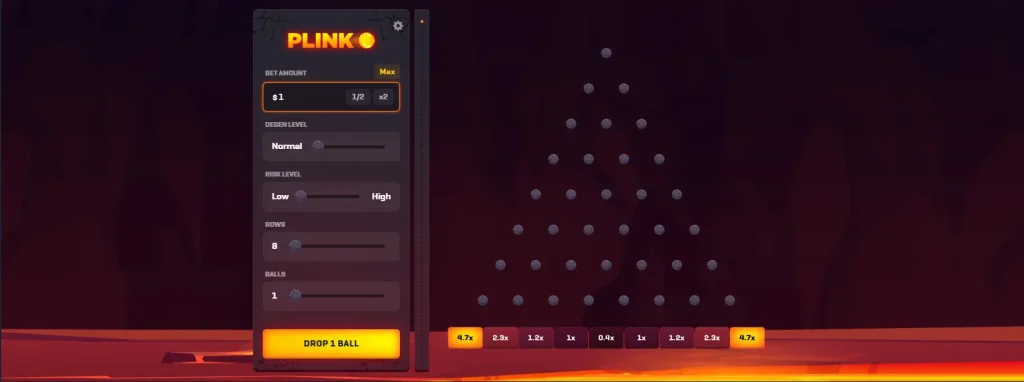
Risk Levels in Rollbit Plinko: Low, Medium, and High
The risk level is the single most important setting in Plinko — it determines how the multipliers are spread across the landing slots before any ball drops. Choosing between the three options is essentially choosing between a consistent but modest return, a balanced middle ground, or the chance at a large payout that lands far less frequently.
| Risk Level | Multiplier Range | Best For |
|---|---|---|
| Low | Narrow, centre-heavy | Consistent returns |
| Medium | Balanced spread | Mixed play style |
| High | Wide, edge-heavy | Big win hunters |
Low risk keeps multipliers clustered toward the centre where most balls land. High risk pushes the valuable slots to the edges, widening the gap between a typical result and a peak outcome.
How Multipliers Are Distributed Across the Grid
The landing slots run along the bottom of the grid in a fixed order — lowest multipliers in the centre, highest at the edges. This isn’t arbitrary: the centre is statistically where most balls end up after bouncing through the pegs, so the payouts there reflect that frequency. Edge slots pay more precisely because reaching them is less likely.
What the risk level changes isn’t the physical layout of the slots — it’s the ratio between what the centre pays and what the edges pay. On a low risk setting, that gap is narrow. Switch to high risk and the peg board multipliers at the edges become significantly larger while the centre value drops, making each drop a more polarised outcome. Same grid, very different value distribution.
Plinko vs Mines vs X-Crash: Picking the Right Original
Each of the three most-played Rollbit Originals is built around a different relationship between player and outcome.
| Parameter | Plinko | Mines | X-Crash |
|---|---|---|---|
| RTP | 99.60% | 99.20% | 98.00% |
| Player decisions | Pre-round only | Multiple per round | One cashout |
| Risk control | 3 preset levels | Full (bomb count) | Timing only |
| Round speed | Fast | Variable | Fast |
| Best for | Passive play style | Strategic players | Thrill seekers |
Plinko is the only Original where the player’s role ends before the round begins — making it the best Rollbit game for anyone who prefers outcome over process.
What Makes Rollbit Plinko Provably Fair?
The landing slot for each ball is decided before it drops — not during, and not after the bet is placed.
- A VRF (Verifiable Random Function) generates the random value used to determine the ball trajectory before each round starts
- That value is processed through BLAKE2b with a 256-bit digest, producing a number that maps to a specific landing slot
- Once the round ends, the original random value is revealed — the Plinko round verification can be reproduced independently using those disclosed inputs
- Rollbit has no mechanism to alter the outcome after a stake is confirmed
- Every historical drop is logged in the account and available for independent review at any time.
Rollbit Plinko RTP and Challenge Pool
A 99.60% RTP means that across all Plinko rounds, $99.60 returns to players for every $100 wagered on average. No other Rollbit Original reaches that figure, and the gap between this and the industry standard — typically 94–96% across slots and most table games — is significant enough to matter over any meaningful volume of play.
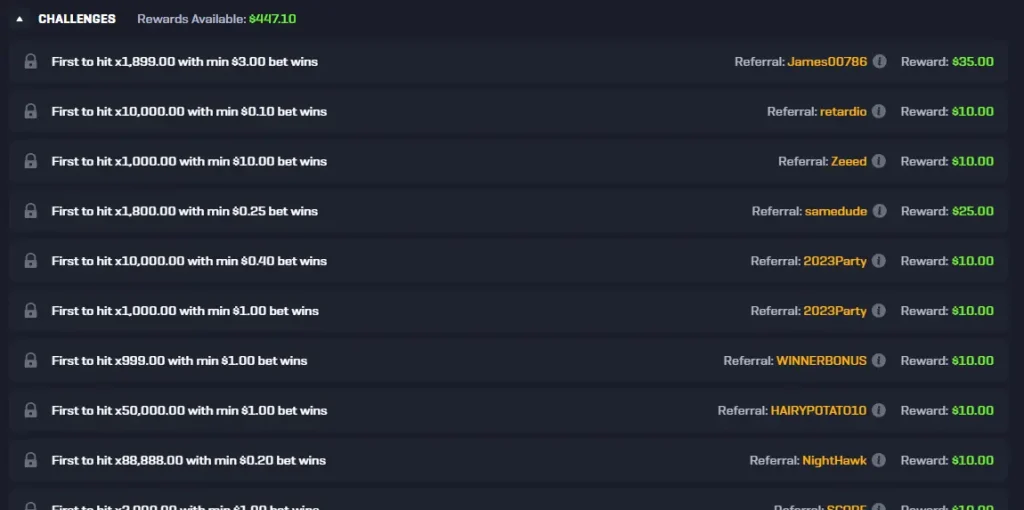
The Challenge Pool sits separately from standard payouts at $447.10, built from a portion of the rake the game generates. Unlike most casino prize structures, this figure is visible before any round begins — players see exactly what the pool contains before committing a stake, which is a level of transparency that most platforms don’t offer.
Row Count and Its Impact on the Game
Row count controls how many times the ball bounces before reaching a landing slot. More rows mean more deflection points — and with each additional peg row, the ball has more opportunities to drift toward the edges rather than settling near the centre.
Fewer rows produce tighter results. The ball doesn’t travel far enough to reach extreme positions, so outcomes cluster closer to the middle of the grid. Add more rows and the spread widens — the same ball can end up significantly further left or right than it would on a shorter grid. Combined with the risk level setting, high risk and high Plinko grid depth together create the widest possible outcome range and the most extreme multipliers available in the game.
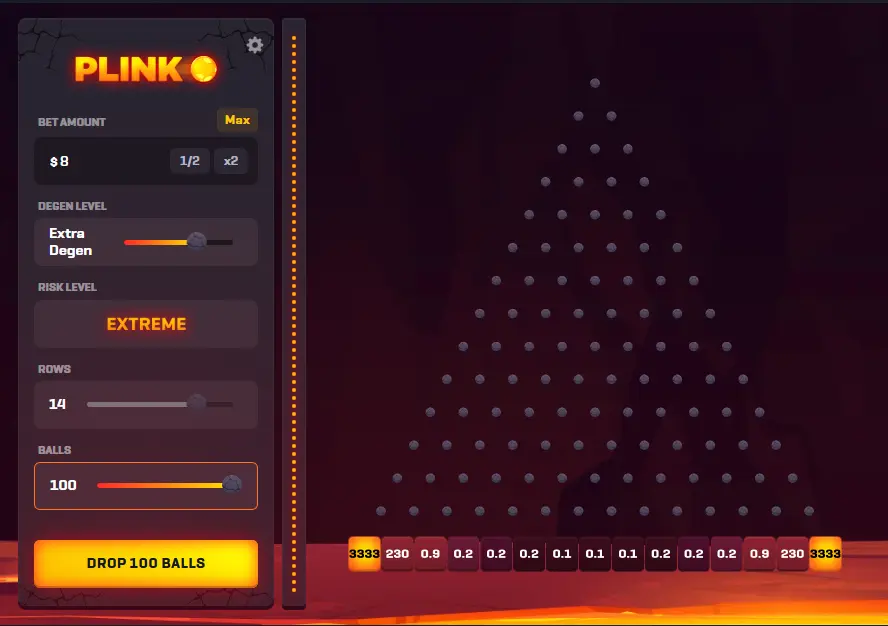
Auto Mode: Running Multiple Drops Without Manual Input
Auto Mode removes the need to manually trigger each drop while keeping every other parameter exactly as set.
- Set the number of drops and the ball falls automatically at the configured stake and risk level
- No round-by-round confirmation required — the sequence runs until the set number completes
- Useful for observing how a specific risk level performs across a series of rounds without active involvement
- RTP and probabilities are identical to manual play — Auto Mode changes the input method, nothing else
- Best suited to players who prioritise volume over individual round management
How to Play Plinko on Rollbit: From Account to First Drop
Getting from login to a live drop takes under a minute.
- Log in to your crypto casino account
- Open the Rollbit Originals section
- Select Plinko
- Choose a risk level — Low, Medium, or High
- Set the number of peg rows
- Enter the stake amount
- Click Drop — the result is instant
The minimum bet is low enough that the first drop carries minimal financial exposure — a practical way to start Plinko on Rollbit and get a feel for how risk levels translate into actual outcomes before increasing the stake.

Plinko on Mobile: Full Game in a Browser
Plinko runs through a mobile browser on both iOS and Android — there’s no separate app to download. The full feature set is available on mobile, including Auto Mode, and the drop animation scales cleanly to smaller screens without losing clarity on the multiplier grid.
For quicker access, adding the Rollbit site to the home screen via the browser’s share menu creates a shortcut that opens directly to the platform — the practical equivalent of an app without the installation.
FAQs
99.60% — the highest figure across all Rollbit Originals.
Only the multiplier distribution changes — RTP stays at 99.60% regardless of which risk level is selected.
Rollbots and Sports Rollbots can be used as stakes, with each NFT’s embedded parameters influencing the final payout.
Yes — Auto Mode runs a set number of drops automatically with fixed stake and risk settings.
It depends on the risk level and row count selected — check the current figure directly on the Plinko game page.